
WE Built 400+ Shopify Stores. Here Are the 7 Things I Wish Clients Knew Before Hiring Anyone
By Meenal, Founder — DigiCloud · Shopify Development Services · Reading Time: 7 min
Over 400 Shopify stores have been built, fixed, migrated, and optimised by our team at DigiCloud over the past 11 years. Clients have been served from the United States, the United Kingdom, Australia, and across India. Spirits brands, automotive parts retailers, kitchen and bathroom suppliers, fashion labels, and print-on-demand businesses have all been worked with — each one arriving with a different product, a different vision, and almost always the same set of avoidable misunderstandings about what a shopify store setup service truly involves.
This post is not a tips article. Generic advice about meta descriptions and mobile optimisation has already been written a thousand times by agencies that have never actually sat inside a client’s Shopify admin at midnight before a product launch. What is being shared here instead are the seven things that have been learned the hard way — through real projects, real mistakes that were witnessed, and real conversations that were had with clients who came to us after things had gone wrong somewhere else. Every point here has been earned, not researched.
1. A Brief That Is Vague Will Always Produce a Store That Disappoints
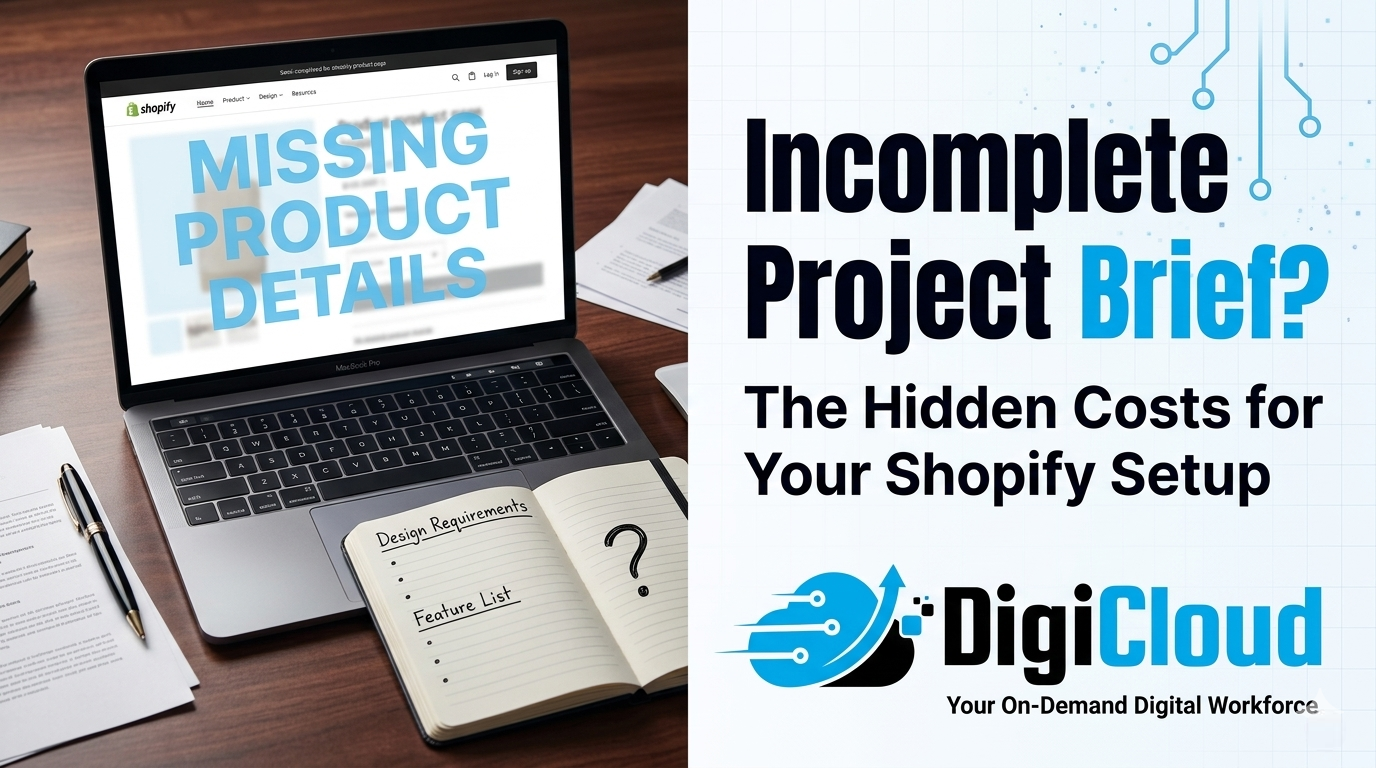
This is the single most common reason that Shopify projects fail — and it is almost never talked about honestly by agencies, because agencies need the work and are reluctant to push back.
When a client arrives and says “I want a clean, modern Shopify store that converts well,” what has actually been communicated is almost nothing. What does clean mean to you? What products are being sold? Are variants involved? Is there a brand guideline? What does your checkout flow need to handle? Is age verification required? Is corporate gifting a use case?
Over the years, it has been observed repeatedly that the stores which performed best after launch were the ones where the most time was spent before a single line of code was written. Thorough briefs were demanded. Questions were asked that clients had not thought to consider. Answers were waited for patiently. Every hour spent clarifying a brief upfront saves approximately three hours of revision work on the back end — and that ratio has been confirmed project after project.
If a shopify store setup service provider is willing to start building without asking hard questions first, that is not efficiency. That is a warning sign.
2. The Platform Is Not the Problem — the Strategy Is
A belief that is encountered constantly, particularly from international clients who have been burned before, is that their previous store failed because of the platform. WooCommerce was blamed. Magento was blamed. A custom build was blamed. And the assumption was made that switching to Shopify would fix everything.
In reality, Shopify is an excellent platform. However, a poorly conceived store on Shopify performs just as badly as a poorly conceived store on any other platform. The store’s failure was caused by the strategy — the product positioning, the user journey, the checkout friction, the lack of trust signals — not by the technology underneath it.
This is something that is always communicated clearly before a project begins. Shopify will be set up properly. Every technical element will be handled correctly. But if the product offering is unclear, if the target audience has not been defined, or if the pricing strategy has not been thought through, no amount of development work will save the conversion rate.
3. Apps Are Not Features — They Are Liabilities Until Proven Otherwise
This point has been written about previously in detail, but it bears repeating here because it is so consistently misunderstood by new clients.
Every app that is installed on a Shopify store adds code to the storefront. That code loads on every page, on every visit, by every customer — whether the app is being actively used on that page or not. Eight casually installed apps can add three to four seconds to a store’s load time. A store that loads in five seconds converts at roughly half the rate of one that loads in two seconds.
When stores are first audited, it is common to find between ten and fifteen installed apps. On average, four of those have not been actively used in over a year — but their code is still running. Removing orphaned app code alone, without changing anything else, has been seen to improve Google PageSpeed scores by fifteen to twenty points in a single session.
The rule that is now applied to every new project is simple: no app is installed unless a specific, measurable business need for it has been identified. Convenience is not a business need.
4. Your Developer and Your Designer Need to Talk to Each Other
This is a structural problem that is seen most frequently with international clients who have assembled their own team — a freelance designer from one platform, a developer from another, a copywriter from a third. Each person does competent work in isolation. Together, the store falls apart.
Design decisions are made that are technically impossible or prohibitively expensive to implement. Developer constraints are not communicated to the designer until after mockups have been approved. Copy is written for a layout that has already changed twice. Three weeks of work are thrown away because nobody was talking to each other during the process.
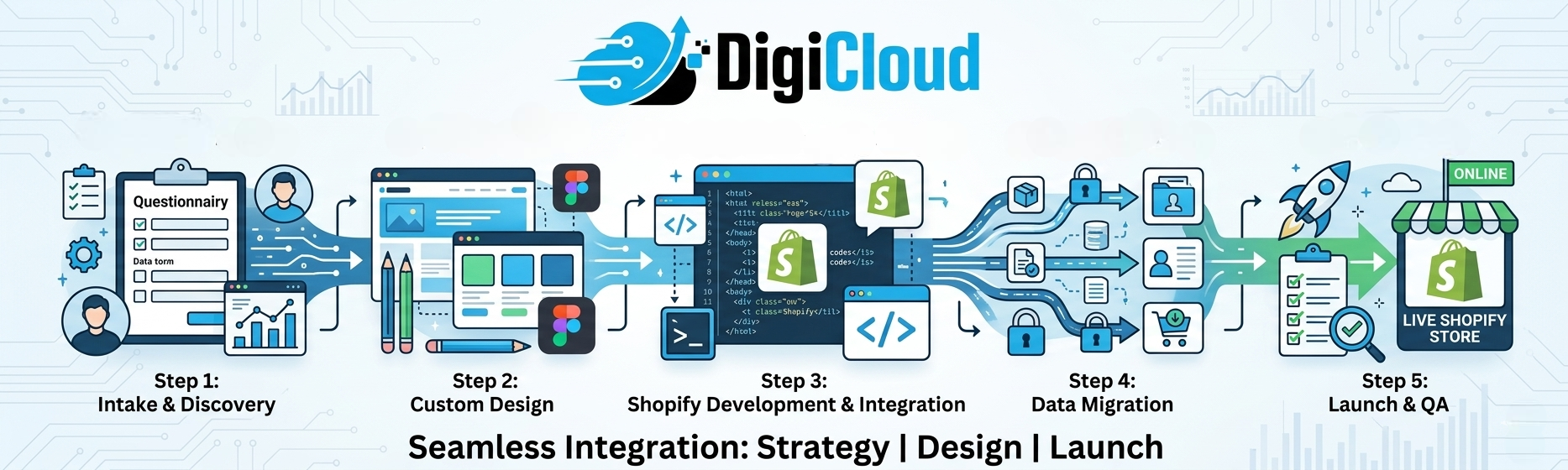
When a shopify store setup service is being delivered properly, the design, development, and content processes are not three separate tracks running in parallel. They are one integrated conversation, managed from a single point of accountability. That is what eleven years of learning to do this badly — and then better — has taught us.
5. The Store Being Live Is Not the Finish Line
One of the most consistent disappointments observed in clients who have worked with other agencies before coming to DigiCloud is the experience of being handed a completed store and then immediately abandoned. The project was delivered. The invoice was paid. Support ended.
What was not accounted for is that a Shopify store is a living system. Products are added. Prices change. Campaigns are run. Apps are updated — and sometimes those updates break things. Shopify itself releases platform updates that occasionally conflict with custom theme code. A store that worked perfectly on launch day can develop problems six weeks later through no fault of its own.
Post-launch support is not an optional extra in our view. It is a core part of what a responsible shopify store setup service should include. Clients are always asked about their ongoing support needs before a project begins, not after it ends.
6. Compliance Is Not Optional — Especially for Regulated Products
This is something that has been learned specifically through working with spirits brands, alcohol retailers, and businesses selling age-restricted or regulated products internationally.
Age verification cannot be an afterthought. Payment gateway restrictions on certain product categories are real and will block your store from processing transactions if they are not handled correctly before launch. Corporate gifting pages for alcohol brands require specific legal language that varies by jurisdiction. Terms and conditions written by a template generator are not sufficient for a business selling regulated goods internationally.
When the GiftedPour spirits store was built, more time was spent on compliance architecture — the age gate, the restricted checkout flows, the corporate gifting pathway, the product descriptions — than on the design itself. That is not unusual for this category. It is necessary. And it is something that a developer who has never worked in this vertical simply will not know to ask about.
7. The Cheapest Quote Is Almost Never the Cheapest Option
This is the hardest thing to communicate to a new client, and yet it is the one that has been proven true more consistently than any other over 11 years of this work.
The full cost of a Shopify store is not the development invoice. It is the development invoice plus the cost of fixing what was done incorrectly, plus the revenue lost while a slow or broken store was live, plus the time spent managing a difficult handover from a developer who disappeared after delivery.
International clients particularly have been seen to arrive having paid a low-cost provider two or three thousand dollars for a store that then required an equal or greater amount of remediation work before it was fit for purpose. The total spend ends up being higher than a properly scoped project with an experienced agency would have cost at the outset.
A fair, transparent quote from a provider with a real portfolio of completed work is not expensive. It is the lowest-risk investment available when starting or relaunching an ecommerce business. That belief has been held at DigiCloud since the beginning — and every project completed since has reinforced it.

A Final Thought
Four hundred stores have been built. Eleven years have passed. The ecommerce landscape has changed considerably — platforms have evolved, customer expectations have risen, and the tools available have multiplied. But the fundamentals of what makes a Shopify project succeed have remained entirely consistent throughout.
Clear briefs. Integrated teams. Honest communication. Proper compliance. Ongoing support. And a refusal to confuse a low price with good value.
These are not complicated ideas. They are simply the things that are kept in mind on every project — and the things that every client deserves to know before they hire anyone to build their store.
📩 Ready for a shopify store setup service built on 11 years of real experience? Get in touch with the DigiCloud team at digicloud9.com — and let’s build something that actually works.