
What Is an Amazon Product Listing Service? Everything Sellers Need to Know in 2026
If you are selling on Amazon — or planning to — you have likely come across the term amazon product listing service. However, many sellers are not entirely sure what it means, what it includes, or whether they actually need one. In 2026, with Amazon’s algorithms more sophisticated than ever, understanding this service is no longer optional. It is essential for any seller who wants to compete, rank, and grow.
At DigiCloud, we provide professional Amazon listing services to sellers across the US, UK, UAE, India, Canada, and Australia. In this complete guide, we answer every question you have about Amazon product listing services in 2026. Moreover, we explain exactly what is included, why it matters, and how to choose the right provider for your business.
This blog is structured as a comprehensive FAQ — because the best way to understand a service is to ask the right questions and get clear, honest answers.
📋
What Exactly Is an Amazon Product Listing Service?
An Amazon product listing service is a professional solution that creates, manages, and optimizes your product pages on Amazon. In other words, it is the process of building your Amazon store’s content — from your product title and images right down to your backend search terms and product attributes.
However, it is much more than simply filling in a form. A professional amazon product listing service combines SEO strategy, conversion copywriting, data accuracy, and algorithm knowledge to build listings that rank and sell. Therefore, it sits at the intersection of technology, marketing, and data management.
Additionally, in 2026, a listing service must account for Amazon’s AI-powered ranking systems — A10, COSMO, and Rufus — which evaluate your listing far beyond simple keyword matching. As a result, the quality of your listing directly determines your organic visibility, your recommendation frequency, and ultimately your revenue.
📦
What Is Included in an Amazon Product Listing Service?
A comprehensive amazon product listing service covers every layer of your listing. Here is a breakdown of what each component involves and why it matters.
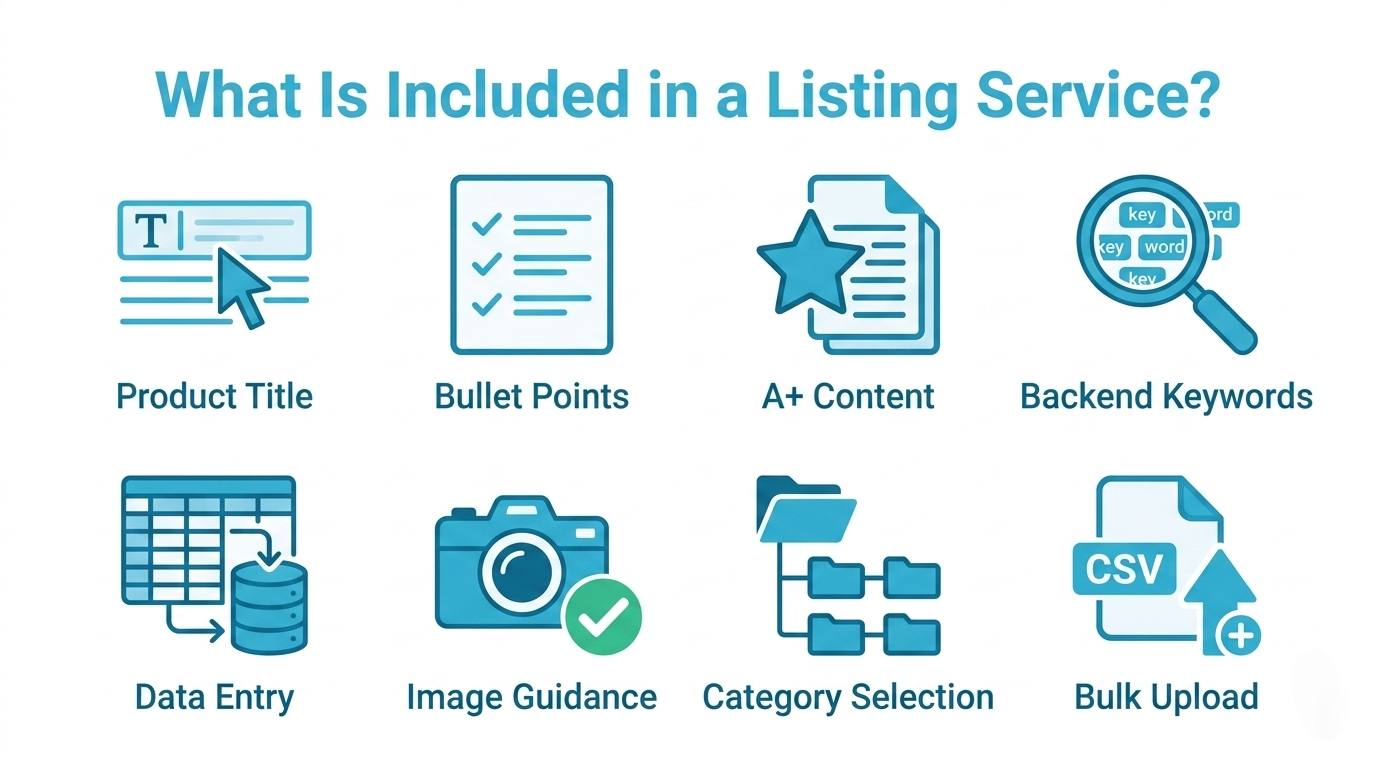
Crafting benefit-led, keyword-rich titles within Amazon’s character limits. The title is the single most important ranking field in your listing and the first thing Rufus AI evaluates.
Writing five specific, factual bullet points that address real buyer concerns. Rufus indexes bullets as a Q&A bank — vague benefits no longer convert or rank in 2026.
Writing compelling product stories and, for Brand Registered sellers, creating rich A+ Content with comparison charts and lifestyle imagery that boosts conversion by 5–10%.
Identifying the right search terms for your backend fields — synonyms, alternate spellings, and long-tail keywords that expand your indexing without repeating visible content. This is the core of amazon seo product listing work.
Accurately filling every mandatory and optional field — SKUs, ASINs, dimensions, weight, material, colour, and all category-specific attributes. Professional amazon product data entry services ensure zero errors and zero suppressed listings.
Advising on image compliance, sequence, and alt text for A+ Content. In 2026, Rufus uses computer vision to evaluate your images — every claim in your listing must be visually proven.
Placing your product in the most relevant category and subcategory. Correct categorization directly affects browse node ranking and filter visibility — a missed node means missed buyers.
Managing large catalogue uploads via Amazon’s flat file CSV templates. Professional amazon product upload services include template validation, error checking, and post-upload auditing at scale.
⚖️
Basic Listing vs. Professional Listing Service: What Is the Difference?
Many sellers create their own listings without professional help. However, the difference in results between a basic self-made listing and a professionally optimized one is significant. The table below shows exactly where the gap lies.
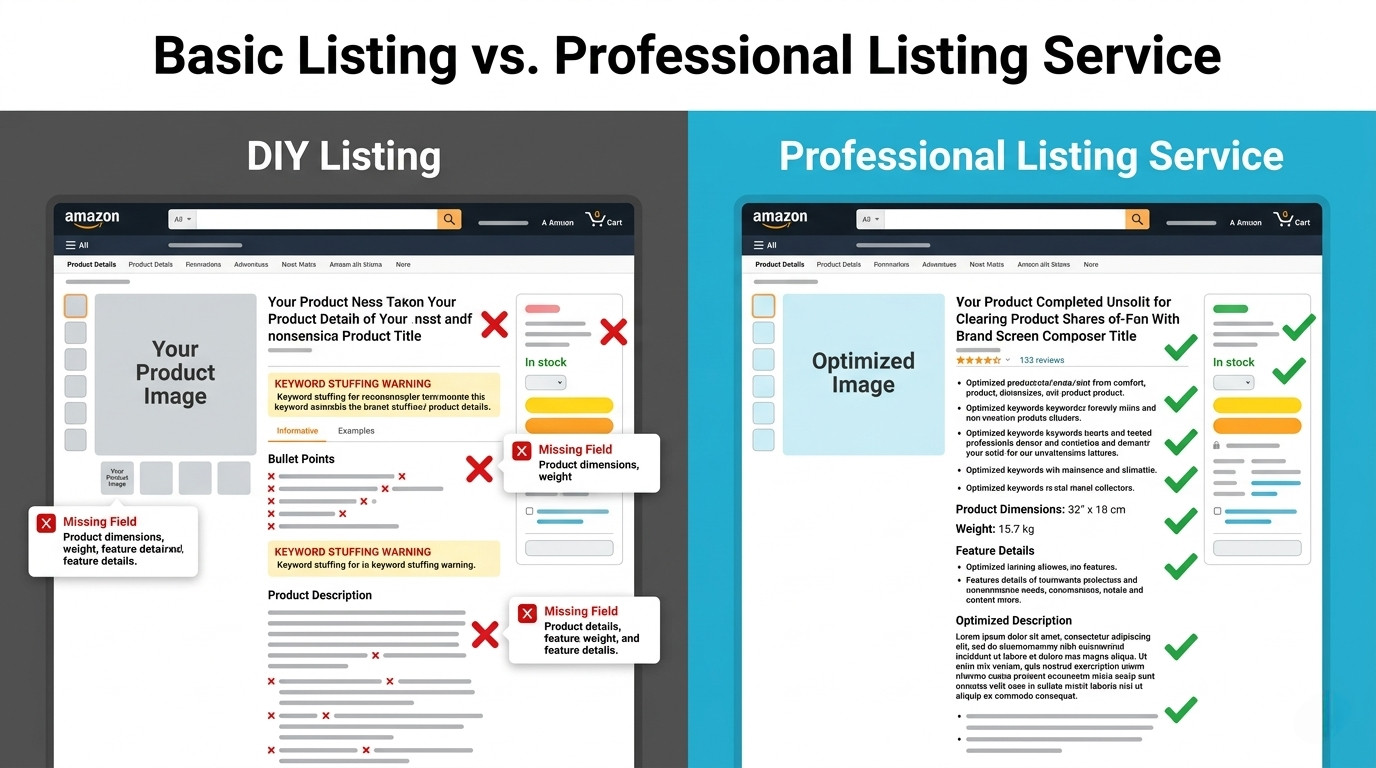
| Listing Element | Basic DIY Listing | Professional Listing Service | Impact |
|---|---|---|---|
| Product Title | Keyword-stuffed, generic | Benefit-led, intent-aligned, Rufus-ready | 🔥 High |
| Bullet Points | Vague benefits, no specifics | Specific, factual, Q&A structured for Rufus | 🔥 High |
| Backend Search Terms | Repeated keywords, incomplete | Researched synonyms, max byte usage, no repetition | 🔥 High |
| Product Attributes | Left empty or filled generically | Every field completed — COSMO knowledge graph fed | 🔥 High |
| Category Selection | Rough guess at best fit | Precise browse node — verified against top competitors | ⚡ Medium |
| Images | Basic photos, no alt text | Compliant, sequenced, alt text added for Rufus vision | 🔥 High |
| Ongoing Monitoring | None — set and forget | Regular audits, suppression alerts, performance tracking | 🔥 High |
🎯
Who Needs an Amazon Product Listing Service in 2026?
Not every seller realizes they need professional help until rankings drop or sales stall. However, the following types of sellers benefit most from a professional listing service.
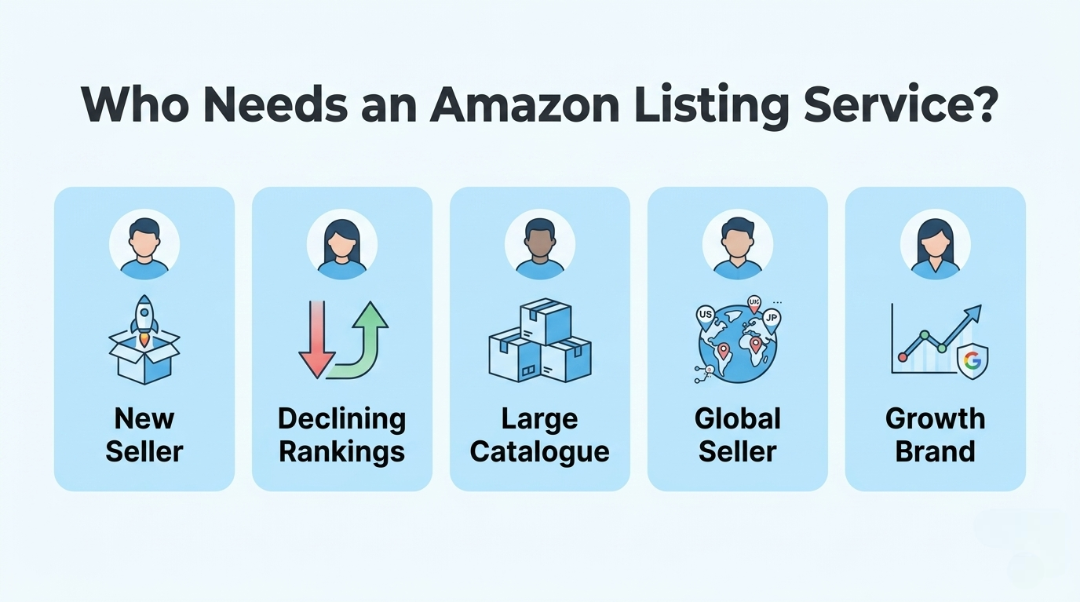
New sellers launching their first products — Getting your first listings right from day one is far more cost-effective than fixing poor-performing listings later. A professional service builds your store on a solid SEO foundation from the start.
Established sellers with declining rankings — If your organic visibility has dropped in 2026, your listings likely haven’t been updated to meet the A10, COSMO, and Rufus standards. A full listing audit and reoptimization restores rankings effectively.
Sellers with large catalogues — Managing hundreds or thousands of SKUs in-house creates inevitable data quality issues. Professional amazon product upload services handle large catalogues with consistent quality at every level.
Global sellers expanding to new marketplaces — Each Amazon marketplace has its own language requirements, templates, and buyer behaviours. Therefore, expanding from US to UK, UAE, India, or Australia without marketplace-specific listing adaptation leads to poor performance.
Brands focused on growth, not operations — Many successful brands choose to outsource their listing management entirely so their team can focus on product development, sourcing, and strategy. As a result, they grow faster without operational bottlenecks.
🤖
How Does an Amazon Listing Service Work Differently in 2026?
Amazon listing services have changed significantly in 2026. Three years ago, the focus was almost entirely on keyword placement. Today, a professional listing service must satisfy three algorithm layers simultaneously.
First, the A10 algorithm still handles keyword indexing. Therefore, your title, bullets, description, and backend terms must contain the right keywords in the right density. However, this is now the baseline — not the goal.
Second, COSMO — Amazon’s knowledge graph — maps your product to real-world buyer intent using your backend attributes. For example, fields like Target Audience, Intended Use, and Subject Matter signal to Amazon exactly who your product is for. Consequently, empty attribute fields create gaps that competitors with complete data will fill.
Third, Rufus AI — Amazon’s generative AI shopping assistant with 300M+ users — reads your listing as a natural-language document. It evaluates whether your content comprehensively answers the questions shoppers are asking. Moreover, it uses computer vision to validate your images against your listing claims. Therefore, every professional listing decision in 2026 must account for all three layers.
At DigiCloud, our amazon product listing service is built around all three algorithm layers. As a result, every listing we create is optimized not just to rank — but to be recommended by Rufus and contextually matched by COSMO.
🔍
How Do You Choose the Right Amazon Listing Service Provider?
Choosing the wrong provider can cost you rankings, time, and money. Therefore, evaluate every potential provider against these five non-negotiable criteria before committing.
🌐
They must understand your specific marketplace — not just Amazon US. Each country has different templates, language requirements, and buyer behaviour.
🤖
They must know A10, COSMO, and Rufus — not just keyword density. Ask them directly how they optimize for Rufus AI before hiring.
📊
They must have a clear QA process for amazon product data entry services — validation, compliance checking, and post-upload auditing.
📈
Ask for case studies or examples of listings they have optimized. Results — not promises — should guide your decision. Check DigiCloud’s portfolio here.